


 Puglia · Dal 1966
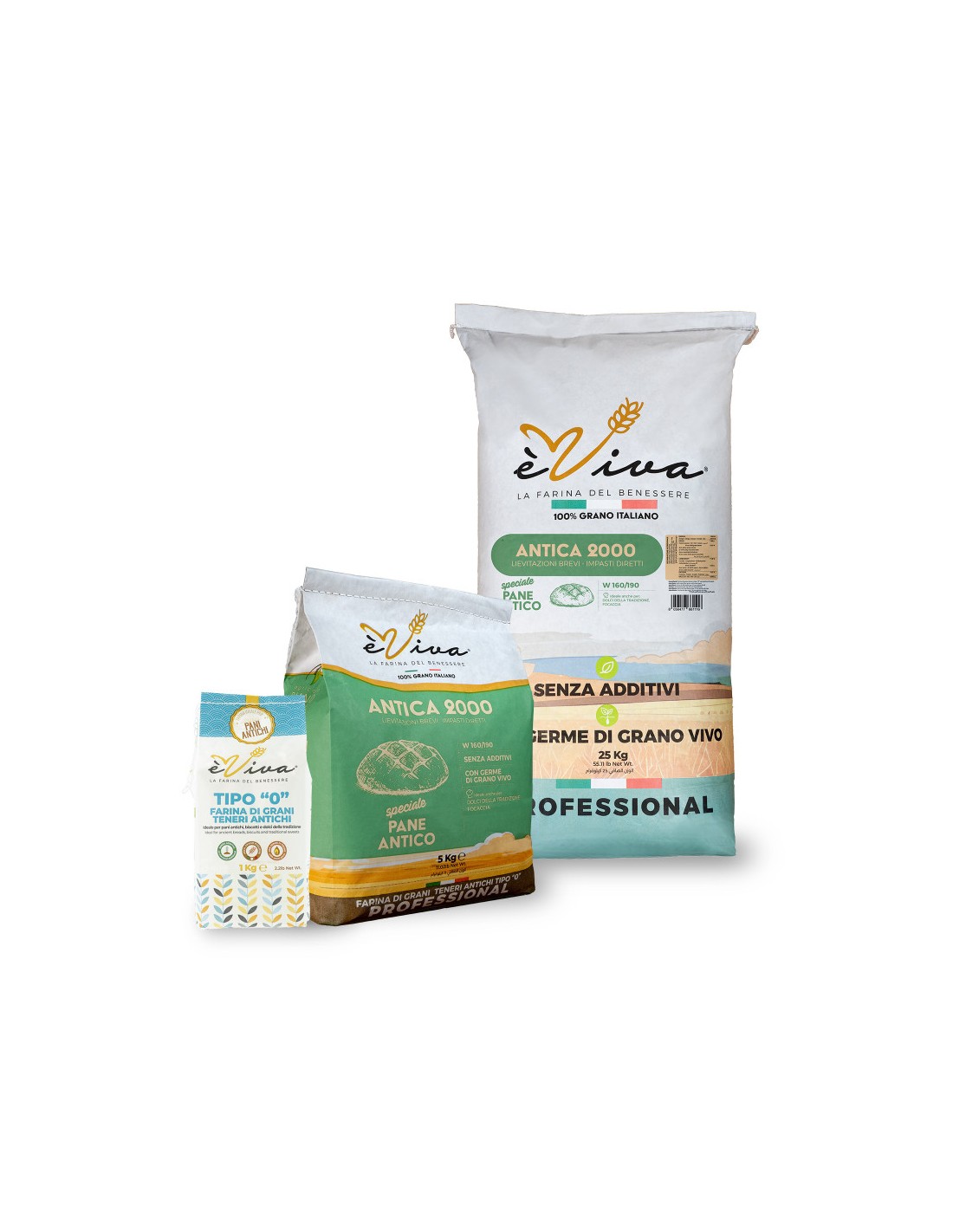
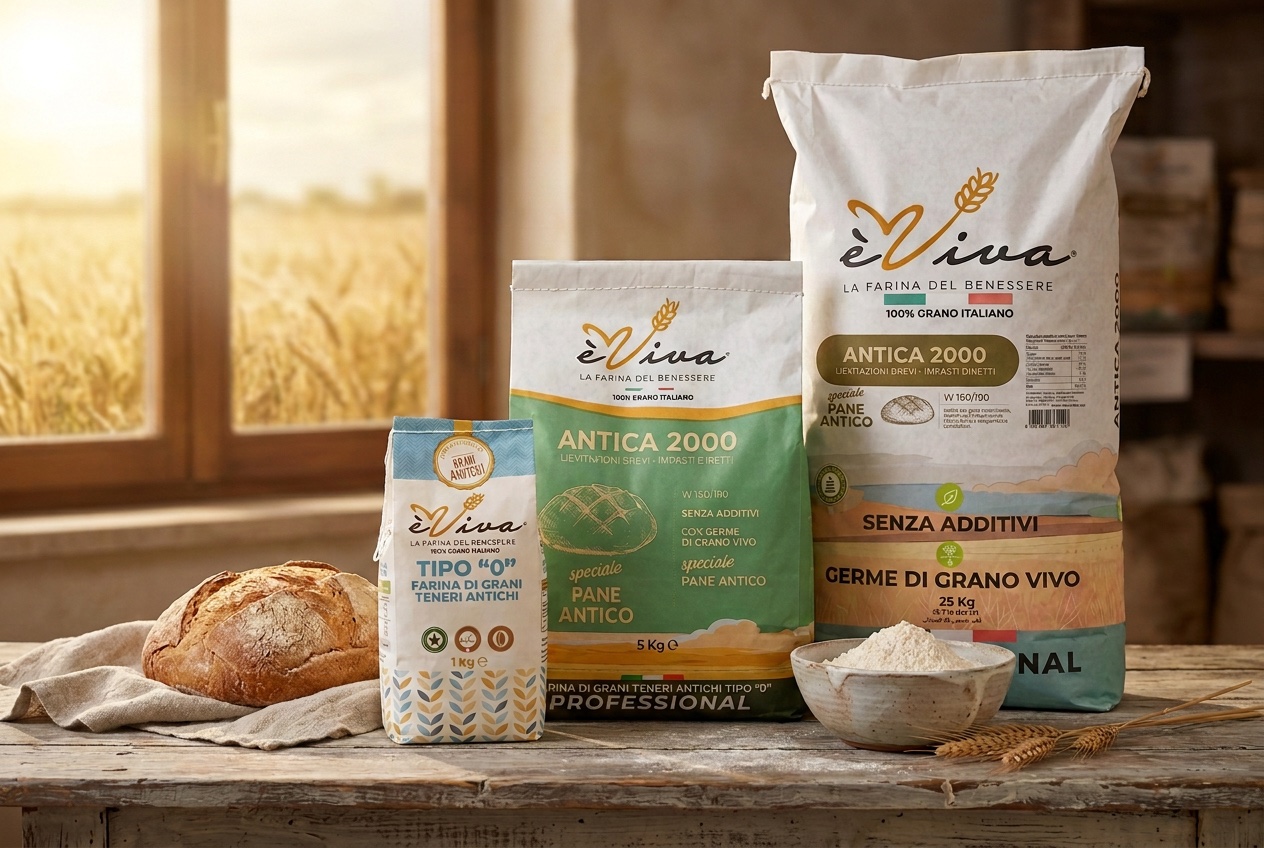
Antica 2.000
Type 0 soft wheat flour from an evolutionary population — W 160–190, with live wheat germ
From an evolutionary population of some 2,000 ancient soft wheat varieties selected by Professor Salvatore Ceccarelli, grown on the Tavoliere delle Puglie without pesticides or glyphosate.
- An evolutionary blend of ~2,000 ancient wheats
- Wheat germ left intact
- No additives, no improvers
- Grown without pesticides or glyphosate
- Secure payment
- Protective packaging
- Traceable supply chain
From field to bag
How Antica 2.000 is made
- The wheat 100% Italian wheat, grown in Apulia under zero-residue integrated farming, with no pesticide residues, glyphosate included.
- The living germ During milling the germ is neither removed nor treated: it stays alive inside the flour.
- Nothing added No enzymes, improvers, added gluten or any other additive: just our own milled wheat.
- The result A natural flour, with the scent and the taste of ancient wheats and great digestibility.
Versatility
Best used for
Low and medium-development doughs, where the aromatic richness of ancient wheats comes through.
- Biscuits and rustic shortcrust.
- Tarts and brisée pastry.
- Crackers, dry grissini and taralli.
- Ancient-style country bread and rustic loaves.
- Short-fermentation focaccia and round pizza by the direct method.
- Fresh pasta, gnocchi and boiled or steamed preparations.
Strength (W)
160–190
Medium-low strength
Direct handling and short fermentations, easy to work even by hand.
- Pastry & biscuits
- Bread & classic pizza
- Contemporary pizza
- Long-matured doughs
Dough sheet
How to work it
Low strength and the naturally softer gluten of ancient wheats make it easy to work by hand, with no professional equipment.
- Method
- Direct, without preferments; a 20–30 minute autolyse is optional
- Hydration
- Good, about 55–60%
- Fermentation at 21–24 °C
- 2–4 hours, adjusted for hydration and yeast
- Cold maturation at 4–6 °C
- Up to 12–18 hours
- Baking, bread and focaccia
- Deck 250–270 °C, top 220–250 °C, 10–15 minutes
Summer: 1 g of baker's yeast per kg of dough, salt 22–25 g per kg of flour. Winter: 2 g/kg, salt 18–20 g/kg.
The difference
Antica 2.000 vs standard type 0 flours
Retail type 0 flours come from varieties selected for industrial yield, stripped of the germ and often standardised with technological additives so performance stays constant whatever the harvest.
- A blend of some 2,000 ancient varieties, not one modern selection
- Wheat germ kept intact throughout milling
- No additives, no improvers, no added enzymes
- A short, traceable chain from sowing to packing
The result is a more intense aroma and better digestibility, thanks to the naturally lower, less tenacious gluten of ancient wheats.
From the field to your table
What a flour made differently is worth
Our flours come out of a different production model from the one large industry uses. This is a farm product, made by hand and in small runs, from wheat we grow ourselves in Puglia and follow from sowing to packing.
Growing 100% Italian wheat, milling in smaller quantities, testing every batch, storing the grain properly and keeping the wheat germ inside the flour all cost more than large-scale industrial production.
Choosing our flour is not just buying a bag of flour. It is buying a natural, artisan product that belongs entirely to our land.
It also means a flour with an identity you can name:
- Italian wheat grown in Puglia
- A short, traceable chain from field to bag
- Integrated farming and laboratory testing
- Live wheat germ kept in the flour
- No added enzymes, improvers, preservatives or vital gluten
- The true aroma and flavour of wheat
Quality you can afford every day
A 5 kg bag makes about 20 tart bases of 24 cm, 250 g of flour each.
Comparison
Not all flours are born the same way
The price of a flour is not set by its strength alone. Behind every bag sit the origin of the wheat, the way it was farmed, the volumes produced, the milling and the decisions taken along the way.
Origin of the wheat
Farm-grown, artisan chain
100% Italian, Tavoliere delle Puglie
Large-scale industrial flour
EU and non-EU markets
Origin of the wheat
100% Italian, Tavoliere delle Puglie
EU and non-EU markets
100% Italian wheat grown on the Tavoliere delle Puglie.
Grain is generally bought on the open market and can come from various EU countries and from outside the EU. Origin and variety are not always disclosed to the consumer.
Selection criteria
Farm-grown, artisan chain
Quality, variety, lab results
Large-scale industrial flour
Technical standard and price
Selection criteria
Quality, variety, lab results
Technical standard and price
Wheat is grown and selected for quality, varietal character, laboratory results and its ability to express the territory.
Large lots are selected and blended to hit standardised technical specifications, with availability and raw-material price also weighing on the choice.
Cost of the raw material
Farm-grown, artisan chain
Our own fields, in Italy
Large-scale industrial flour
Bought on world markets
Cost of the raw material
Our own fields, in Italy
Bought on world markets
Italian cultivation, direct control of the fields and production in smaller quantities all cost more.
Large volumes and the option of buying wheat on international markets — often below the price of Italian wheat — keep costs down.
Production volumes
Farm-grown, artisan chain
Small, controlled batches
Large-scale industrial flour
Large scale, cost per kilo
Production volumes
Small, controlled batches
Large scale, cost per kilo
Smaller, controlled batches, with closer attention to the raw material and to the milling.
Large-scale production and economies of scale, aimed at standardisation and at a lower cost per kilo.
Wheat germ
Farm-grown, artisan chain
Alive, never separated
Large-scale industrial flour
Separated, or added back treated
Wheat germ
Alive, never separated
Separated, or added back treated
The wheat germ is kept alive inside the flour: never removed, never treated.
In refined flours the germ is generally separated out to increase stability and shelf life. Where it is added back, it has been stabilised or treated first.
Enzymes and improvers
Farm-grown, artisan chain
No added additives
Large-scale industrial flour
Enzymes, vital gluten, improvers
Enzymes and improvers
No added additives
Enzymes, vital gluten, improvers
No added enzymes, improvers, preservatives, emulsifiers or vital gluten. Performance comes from the quality of the wheat and from milling it properly.
Unless the bag explicitly says "no added additives", industrial flours commonly carry added enzymes, vital gluten, improvers and other processing aids, used to make performance more uniform and repeatable.
Traceability
Farm-grown, artisan chain
One batch, field to bag
Large-scale industrial flour
Lots pooled and blended in silos
Traceability
One batch, field to bag
Lots pooled and blended in silos
Every batch is followed directly from field to bag: sowing, growing, harvest, storage, milling and packing.
Even when it is declared Italian, the wheat used in large productions can come from many different farms and areas. Batches are pooled in silos and blended, which makes it effectively impossible to trace the individual grower, the field, the variety or the harvest window.
Traceability becomes even less transparent when the stated origin is simply "EU" or "non-EU", because the consumer cannot even learn which country the wheat came from.
Farming method
Farm-grown, artisan chain
Zero residue, test reports on file
Large-scale industrial flour
Protocol not disclosed
Farming method
Zero residue, test reports on file
Protocol not disclosed
100% Italian wheat grown on the Tavoliere delle Puglie, in unusually favourable soil and climate conditions and inside an Italian farming system with strict controls protecting both the land and the consumer.
We follow our own zero-residue integrated farming protocol and intervene only when it is necessary. Analyses on our wheat have found no pesticide or glyphosate residues, and no mycotoxin or heavy-metal contamination — results we can show through the corresponding test reports.
Conventional farming permits plant protection products within the limits set by law. Without a specifically controlled chain and published analyses, the consumer does not know which agricultural protocol was followed, which treatments were applied, or whether residues remain in the product.
In large chains, especially where imported grain travels and is stored for long periods, the risk is not only insects. Wheat may be treated in the field against fungal disease and again during storage to control infestation.
Conditions inside the silos matter just as much: humidity, temperature and ventilation that are not properly controlled can encourage fungal growth and raise the risk of mycotoxins forming or accumulating, DON among them. That is why constant monitoring and specific analyses are essential both at harvest and during storage — information that ordinary industrial flours rarely make available to the consumer.
Keeping qualities
Farm-grown, artisan chain
8 months advised, not a deadline
Large-scale industrial flour
More stable, preservatives allowed
Keeping qualities
8 months advised, not a deadline
More stable, preservatives allowed
Live wheat germ makes the flour naturally richer, and also more sensitive to time, heat, humidity and swings in temperature. It therefore needs more care in storage than a flour stripped of its germ.
The eight months printed on the pack are the period we recommend for enjoying the aroma, the flavour and the technical behaviour at their best — not a hard expiry date. Kept somewhere cool and dry, away from light, strong smells and temperature swings, the flour holds its qualities well beyond the best-before date.
Separating or stabilising the germ reduces the oils and the enzyme activity naturally concentrated in that part of the grain. The flour is then more stable, less prone to oxidation and generally easier to keep for a long time. Shelf life can be extended further through stabilising treatments, protective packaging and — in products and formulations where it is permitted — substances acting as preservatives.
Nutritional profile
Farm-grown, artisan chain
Oils, vitamins and minerals of the germ
Large-scale industrial flour
Lost along with the germ
Nutritional profile
Oils, vitamins and minerals of the germ
Lost along with the germ
The germ naturally retains the oils, vitamins, minerals and enzymes of the wheat.
Separating the germ also removes some of the substances naturally present in that living part of the grain.
Aroma and flavour
Farm-grown, artisan chain
Wheat, cereal, straw
Large-scale industrial flour
A more neutral profile
Aroma and flavour
Wheat, cereal, straw
A more neutral profile
Our wheat is grown on the Tavoliere delle Puglie, harvested at the right moment and stored in controlled conditions to protect its freshness and its natural character.
Through milling we keep the live wheat germ inside the flour. That care for the raw material, and the germ itself, preserve a richer and more recognisable sensory profile, with genuine notes of wheat, cereal and straw.
Those aromas carry into the dough and into the baked product, to which the flour lends more aromatic intensity, more flavour and more identity.
Blending large lots of wheat from different varieties, growers and countries is done above all to obtain uniform technical characteristics. Long transport and storage in silos, the conditions of that storage and any treatments the grain has undergone can all affect its freshness and its aromatic profile.
On top of that comes the separation of the germ during refining. Removing the living part of the grain, naturally rich in oils and aromatic compounds, gives a more stable and more standardised flour — but generally a more neutral one, in which the original aroma and flavour of the wheat are harder to recognise. This is why many industrial products can taste anonymous.
Final price
Farm-grown, artisan chain
Direct sale, transparent price
Large-scale industrial flour
Brand, advertising, middlemen
Final price
Direct sale, transparent price
Brand, advertising, middlemen
The price reflects the real cost of 100% Italian wheat grown in Puglia, of production in controlled batches, of the analyses carried out, of storing the harvest properly and of the decision to keep the germ alive inside the flour.
Selling directly from the producer removes intermediate steps and commercial costs, which lets us offer a farm-grown artisan flour at a transparent price — one that can even come in below some branded industrial flours.
Production cost can already be lower at the raw-material stage: wheat bought in bulk on international markets, above all outside the EU, is often cheaper than European and especially Italian wheat. Add automated processes, large volumes and economies of scale, and the cost per kilo falls further.
That does not mean industrial flour always reaches the shelf at a lower price: brand value, advertising, distribution, intermediaries and commercial positioning can all weigh heavily on what the shopper pays. Some industrial flours cost as much as ours, or more, despite starting from lower production costs.
Two different production models
Industrial flour answers the needs of large-scale production above all: uniformity, long shelf life and a contained price.
Our flours come from a different choice: growing our own wheat, following it from field to bag, keeping its germ, and adding nothing to correct its performance artificially.
That is why it costs more. What it offers in return is a certain origin, a short chain, naturalness and the true flavour of wheat.
Per 100 g
Nutritional values
Technical data
Specifications
Parameters per the producer's technical specification. Live wheat germ can occasionally attract small insects: simply sift the flour before use.
Quality checks
Food safety
An untreated flour: no additives, no technological improvers, no added enzymes.
- Italian non-GMO wheats (Reg. EC 1829/2003 and 1830/2003)
- Grown without synthetic pesticides or glyphosate
- Suitable for a vegan diet
- A short chain traced from sowing to packing
Notice
Allergens
Contains gluten. May contain traces of soy, molluscs and mustard. Free from milk, eggs, fish, peanuts, nuts, celery, sesame, sulphites and lupin.
Verified reviews
What èViva customers say
Flour of the greatest quality. Working it by hand you can feel the difference with commercial flours. The flavour, especially paired with sourdough, is thrilling and distinctive.
Very workable flour and it gives an incredible taste and aroma!
I use Agricolapiano's flours and I am very happy, and I know that after 6 months you can expect a few surprises: I call this genuineness.
FAQ
Frequently asked questions
In which formats is it available?
How should it be stored?
Is it non-GMO and vegan-friendly?
Why is a flour with the germ different?
What are the ancient wheats in the blend?
Can I use it with biga or poolish?
What is the W strength of Antica 2.000, and what is it for?
How much water does Antica 2.000 absorb, and how long should it prove?
Which mixing method suits Antica 2.000?
Which wheats go into Antica 2.000, and where are they grown?
Why does a living flour need to be stored properly?
Continue exploring
Other recommended products
Ready to try Antica 2.000?
From an evolutionary population of some 2,000 ancient soft wheat varieties selected by Professor Salvatore Ceccarelli, grown on the Tavoliere delle Puglie without pesticides or glyphosate.