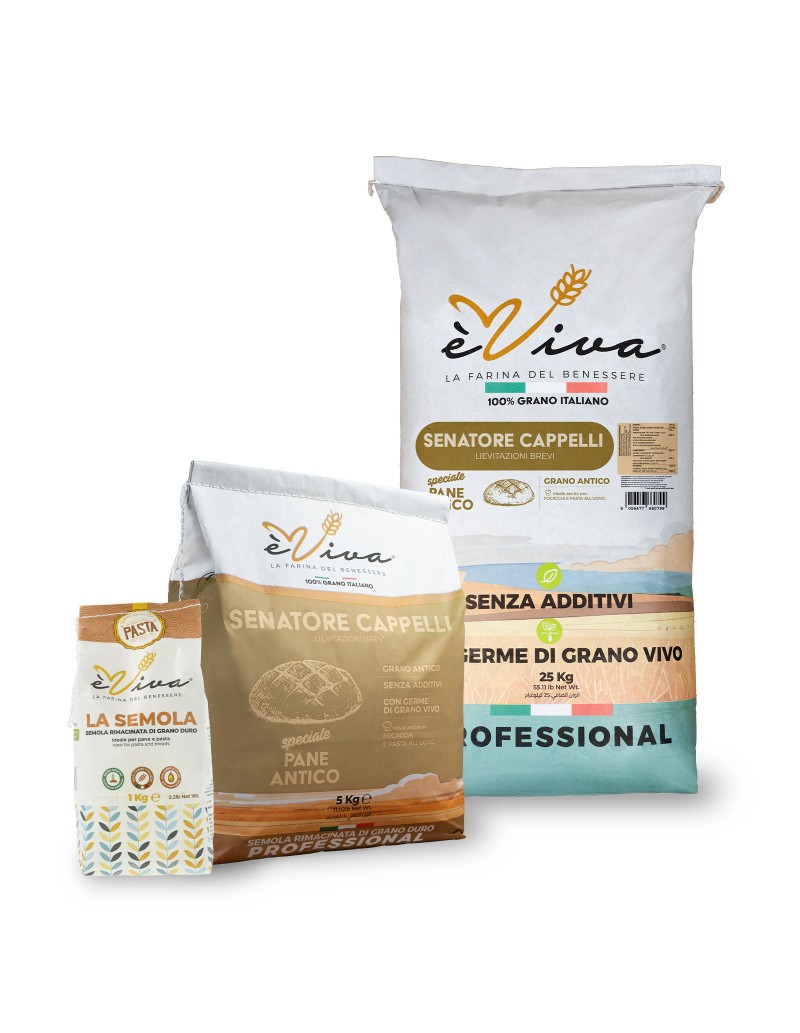
Ancient durum wheat remilled semolina Senatore Cappelli: the early-1900s cultivar, grown in Puglia without glyphosate.
Chosen by professionals
Our remilled semolina comes exclusively from Senatore Cappelli durum wheat, an ancient cultivar selected in the early 1900s and grown in the heart of Puglia with voluntary integrated farming.
Ancient grain — 100% Senatore Cappelli, a historic Italian cultivar.
Glyphosate-free — Voluntary integrated farming, no pesticides or chemical residues.
Live germ — For aroma, nutrition and a soft crumb.
Order before 14:00 for same-day shipping
Secure payment
Protective packaging
Traceable supply chain
Versatility
Ideal for
Senatore Cappelli enhances the most varied preparations, in the kitchen and at the table.
Soft-crumb semolina bread (direct method with 30–60 min autolysis).
Traditional semolina sweets, sweet taralli, schiacciate and rustic friselle.
From field to mill
100% Apulian supply chain, integrated and traceable
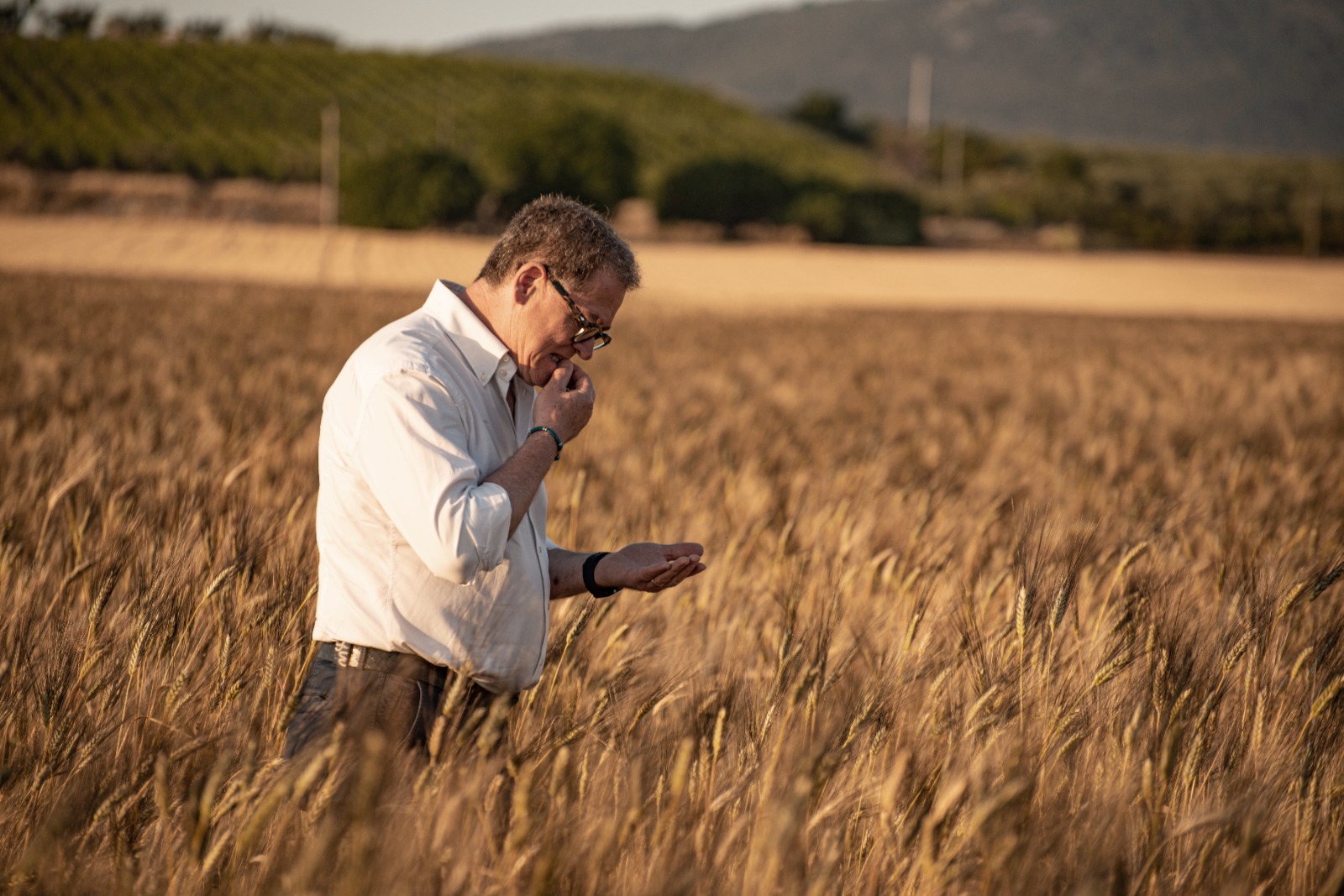
All èViva flours come from our wheats grown in the heart of Puglia, in Apricena (FG), through voluntary integrated farming practices: no glyphosate, no synthetic pesticides, no GMOs (EC Reg. 1829/2003 and 1830/2003).
Every batch is traced from field to bag: from seed to harvest, from refrigerated silo storage to milling, up to packaging in our Apricena facility. A short, controlled and verifiable supply chain that ensures the purity and varietal identity of every lot.
Technical data
Specifications
NameRemilled durum wheat semolina
CultivarSenatore Cappelli (ancient, selected in the 1920s by Nazareno Strampelli)
W (E-4 Joule)< 130 (weak, extensible gluten)
P/LLow — extensible but fragile dough
Protein (N×5.70 d.m.)min 13%
Ash (d.m.)0.94 ± 0.06%
Hagberg indexmin 200 sec
Liquid absorptionup to 65%
Shelf life8 months (up to 12 months if stored correctly)
How to use it
Practical tips for use
Senatore Cappelli semolina requires a respectful approach. The direct method is the only one recommended, with a mandatory 30–60 minute autolysis before the final working. The weak gluten of the ancient grain does not withstand biga or poolish, which would make the dough fragile, sour and underdeveloped.
Recommended guidelines
Method: exclusively direct with mandatory 30–60 minute autolysis
Hydration: controlled, up to 65%
Proofing: 3–5 hours at room temperature (21–24 °C)
Cold maturation: up to 18–24 hours maximum
Water management: 50% with the semolina, then gradually add the remaining half
In summer use refrigerated water at 4 °C with 1 g of fresh yeast per kg of dough and salt at 22–25 g/kg; in winter tap water with 2 g/kg of yeast and salt at 18–20 g/kg. Beyond 24 hours in the fridge the gluten structure degrades irreparably: for bronze-drawn dried pasta, compact bread or long fermentations go for Proteica 14.
100 g
Nutritional values
Energy352 kcal / 1495 kJ
Fat1.95 g (of which saturates 0.33 g)
Carbohydrate70.1 g (of which sugars 0.36 g)
Protein13.63 g
Salt0.006 g
Controls
Food safety
Every èViva flour is produced under rigorous controls on raw material and process, with full supply-chain traceability.
100% Italian wheat, grown in Puglia
With live wheat germ
Without glyphosate or synthetic pesticides
Free from added additives, enzymes or improvers
Roller milling at low temperature, in small batches
Integrated and transparent agricultural supply chain
Non-GMO (EC Reg. 1829/2003 and 1830/2003)
Suitable for a vegan diet
Every pack shows batch number, milling date and packaging date
Warnings
Allergens
Contains gluten (cereals containing gluten); possible traces of soy, molluscs and mustard.
Available formats
Sacco 1 kg — cod. 452 · EAN 8056477660805
Sacco 5 kg — cod. 453 · EAN 8056477660782
Sacco 25 kg professional — cod. 455 · EAN 8056477660799
Frequently asked questions
FAQ — Senatore Cappelli
What kind of flour is Senatore Cappelli?
It is an ancient durum wheat remilled semolina obtained exclusively from the Senatore Cappelli cultivar, grown in Puglia with voluntary integrated farming, without glyphosate. It has a very low W (<130), delicate gluten and retains the live wheat germ: it is designed for soft semolina bread, hand-made fresh pasta and rustic sweets.
Who was Senatore Cappelli and why does the wheat bear his name?
Raffaele Cappelli was a senator of the Kingdom of Italy who promoted the early-twentieth-century agrarian reform in the South. The durum wheat cultivar was developed by the agronomist Nazareno Strampelli through genealogical selection from a North African variety and officially released in the 1920s. For decades it was the most widely grown durum wheat variety in Italy.
Why does it have such a low W (<130) despite having 13% protein?
Senatore Cappelli has a high protein content but a naturally weak gluten network: the quality of the gluten is different from that of modern durum wheats. This structural feature is precisely what makes it more digestible and more aromatic, but it requires the direct method, mandatory autolysis and fermentations of no more than 18–24 h in the fridge.
What preparations is Senatore Cappelli semolina recommended for?
Soft-crumb semolina bread (direct method with 30–60 min autolysis), pan pizza and rustic focaccia at low hydration, hand-made fresh pasta (orecchiette, troccoli, cavatelli, tagliatelle), traditional semolina sweets, sweet taralli, schiacciate and rustic friselle.
Is it good for home-made dried pasta?
No, it is not the recommended choice: the weak gluten network does not withstand the cooking hold typical of bronze-drawn dried pasta. For that use Proteica 14 is more suitable. Senatore Cappelli is instead at its best with hand-made fresh pasta.
What is the difference with Proteica 14?
Senatore Cappelli (W<130) is a weak semolina designed for soft semolina bread, hand-made fresh pasta and rustic sweets: you choose it for flavour and digestibility. Proteica 14 (W 200–220, P/L 3.66) is a medium-strength semolina for bronze-drawn dried pasta, compact bread and fermentations up to 48 h. They are not interchangeable.
How much water does it absorb?
Up to 65% of its weight, but it should be hydrated slowly: the 30–60 minute autolysis is essential so that the semolina develops its structure correctly before the final working.
Why is autolysis mandatory?
The weak gluten of the ancient grain does not withstand prolonged fermentations or indirect methods (biga, poolish). A 30–60 minute autolysis improves hydration, plasticity and dough hold before the final working, and it is the only way to obtain a stable structure with this semolina.
Is it suitable for sourdough?
Yes, in the final doughs of semolina bread with short fermentations (max 18–24 h). It is not, however, recommended for refreshing sourdough, where a higher-strength flour is needed.
What is the difference between this semolina and a supermarket durum wheat flour?
A single cultivar (Senatore Cappelli), traced from field to bag, grown in Puglia without glyphosate, live wheat germ kept in during milling. It is not an anonymous blend of durum wheats: it is a signature semolina with intense aroma and superior digestibility.
Why is live wheat germ important?
It contains oils, enzymes and nutrients that stay naturally present in the semolina: they give more aroma, a natural golden-yellow colour, digestibility and better softness retention in the finished product.
Does it contain additives or improvers?
No. It is a 100% natural semolina, non-GMO, without additives, added enzymes or improvers. It contains no glyphosate and comes from voluntary integrated farming.
In which formats is it available?
1 kg bag (code 452 — EAN 8056477660805), 5 kg bag (code 453 — EAN 8056477660782) and 25 kg professional bag (code 455 — EAN 8056477660799).
The first time I tasted the Type 0 flour for pizza I was amazed by such authentic flavours, and the same goes for the type 1 and type 2.
Flour of the greatest quality. Working it by hand you can feel the difference with commercial flours. The flavour, especially paired with sourdough, is thrilling and distinctive.
I use Agricolapiano's flours and I am very happy, and I know that after 6 months you can expect a few surprises: I call this genuineness.
Senatore CappelliAncient durum wheat remilled semolina Senatore Cappelli: the early-1900s cultivar, grown in Puglia without glyphosate.